
Images on this website are licensed under a
Creative Commons Attribution-NoDerivs 3.0 Unported License.
OBJECT
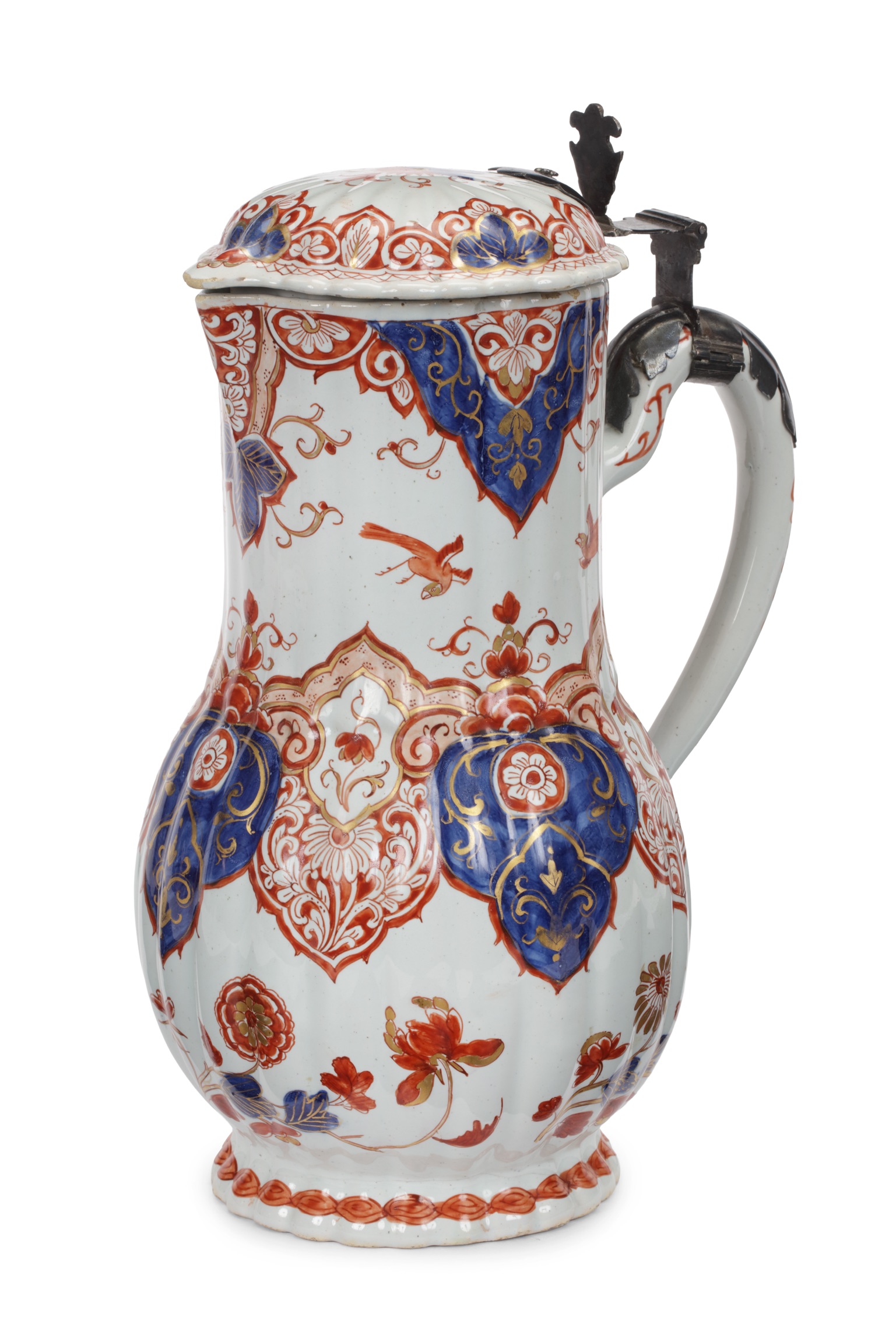
D2629. Imari Gilded Ewer
Delft, circa 1710
Marked PAK No 8 in iron-red for Pieter Adriaensz. Kocx, the owner of De Grieksche A (The Greek A) factory from 1701 to 1703, or his widow Johanna van der Heul, the owner of the factory from 1703 to 1722
DIMENSIONS
Height: 26 cm. (10.2 in.)
NOTE
The term Imari refers to wares manufactured at the Arita kilns in Japan and exported via the port of Imari from the 1650s onward. Following the collapse of Chinese export porcelain in the mid-seventeenth century, the Dutch East India Company (VOC) channeled large quantities of Japanese porcelain into European markets. These wares were prized for their vibrant palette of underglaze cobalt blue, rich iron-red enamels, and extensive use of gilding. The distinctive Imari aesthetic, bold, rhythmically patterned, and densely ornamented, captured the enthusiasm of Dutch collectors and became a defining influence on Delft polychrome wares.
Delft potters responded to the popularity of Imari by adapting its key visual characteristics. Delftware painters translated Imari schemes into a painterly language suited to tin glaze, often emphasizing symmetrical patterns, stylized floral motifs, and extensive gilded decoration. The present ewer exemplifies this synthesis: its surface is articulated with ornamental panels and lobed cartouches filled with scrolling tendrils, palmettes, and abstracted floral elements rendered in a restrained yet resonant palette of deep cobalt and iron-red, enhanced by gold accents.
The form of the ewer is equally telling. While its decoration draws overtly from Imari models, its silhouette, complete with a hinged lid and applied handle, is rooted in European metalwork prototypes. This hybridization underscores how Delftware functioned as a mediator between imported aesthetics and domestic utility. The piece was intended for use in a European context, where it might have served at table or within a display ensemble, its form familiar even as its surface conveyed a cosmopolitan sensibility.
Under Pieter Adriaensz. Kocx, and even more prominently under the direction of his widow Johanna van der Heul, De Grieksche A emerged as one of the leading Delft factories specializing in polychrome wares. The factory’s production is distinguished by its refined enamel work and its sophisticated adaptation of international decorative idioms. Objects bearing the PAK mark consistently reveal a high level of technical assurance in color application and compositional clarity, reflecting a factory keenly responsive to contemporary taste while actively pursuing painterly and stylistic innovation.
 CHINESE 阿伦森 WEBSITE