
Images on this website are licensed under a
Creative Commons Attribution-NoDerivs 3.0 Unported License.
OBJECT
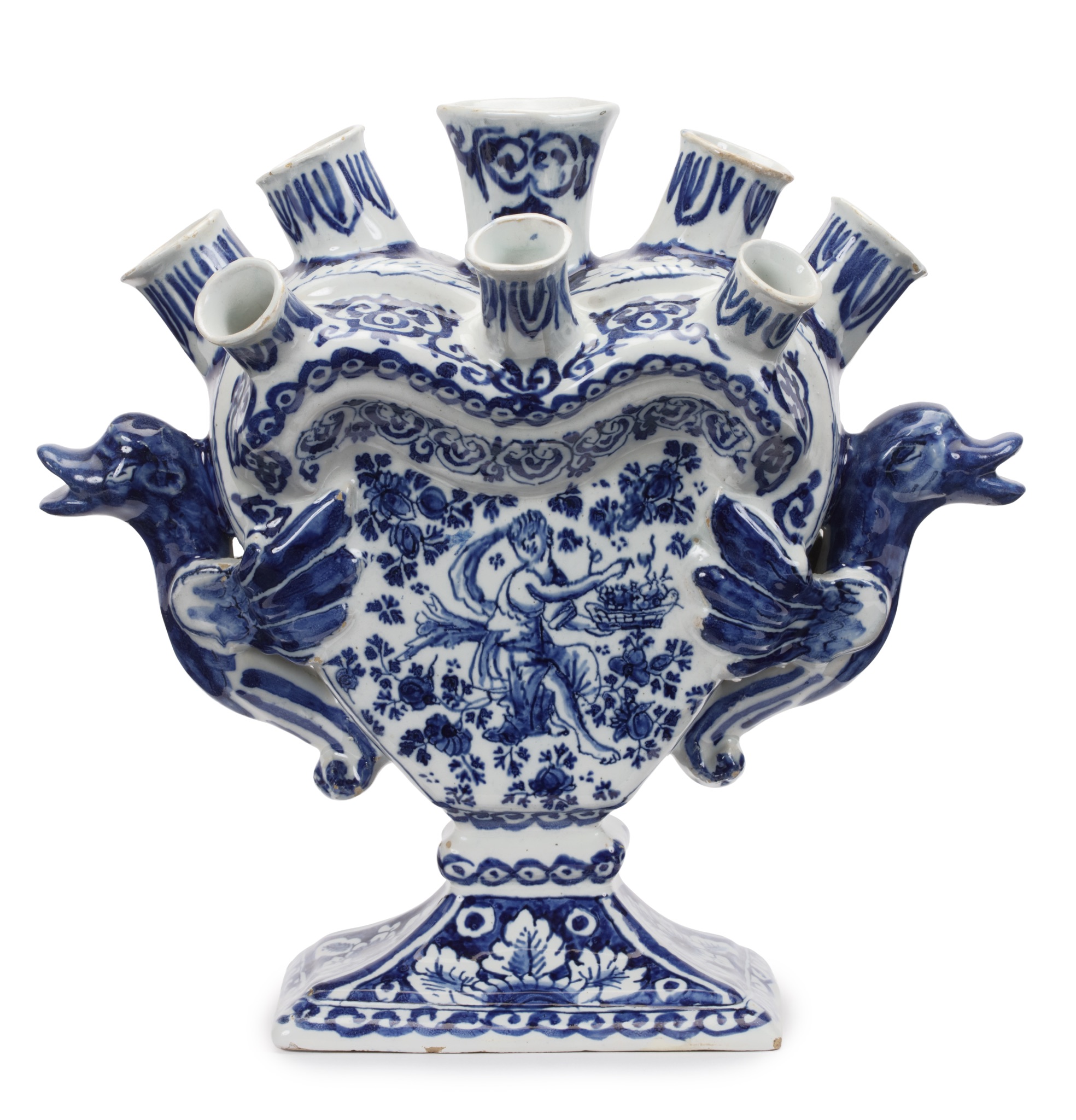
•D2626. Heart-Shaped Flower Vase
Delft, circa 1710
Marked LVE 1 0 CB + in blue for Lambertus van Eenhoorn, the owner of De Metaale Pot (The Metal Pot) factory from 1691 to 1721 or his widow Margaretha Teckmann from 1721 to 1724
DIMENSIONS
Heights: 20.4 cm. (8 in.)
PROVENANCE
Dutch Private Collection;
Aronson Antiquairs, Amsterdam
NOTE
The front of this heart-shaped flower vase is painted with Flora, shown draped in flowing garments and holding a basket of fruit, surrounded by small floral sprigs and cross motifs that are repeated on the reverse. Her calm yet animated pose and the abundance of vegetal attributes identify her unambiguously as the Roman goddess of spring, flowers, and the renewal of nature.
Flora occupied a prominent position in the decorative repertory of late seventeenth- and early eighteenth-century Delftware. Rooted in classical mythology, she was associated with seasonal regeneration, fecundity, and the cyclical rhythms of the natural world. These associations made her an especially appropriate subject for spouted flower vases, objects whose very function was to support and display freshly cut blooms. In this context, Flora’s presence operates both symbolically and conceptually: she personifies the life-giving forces that the vase was designed to showcase.
Her imagery resonated strongly with contemporary intellectual and cultural currents in the Dutch Republic. The period witnessed a growing fascination with botany, stimulated by scientific inquiry, the establishment of botanical gardens, and the influx of new and exotic plant species through global trade networks. Flowers became objects of study, prestige, and connoisseurship, and their cultivation was closely linked to social status and refined taste. Within this climate, Flora came to embody not only natural fertility but also the cultivated appreciation of nature as shaped by human knowledge and artistic sensibility.
On Delftware, and particularly on multi-spouted flower vases, Flora thus functions as a mediating figure between nature and art. Her classical origins lent intellectual authority and cultural prestige, while her floral attributes aligned her with contemporary horticultural interests. The depiction of Flora on this vase reflects the convergence of classical allegory, early modern botanical culture, and the aesthetic ambitions of Delft potters at the turn of the eighteenth century, transforming a functional object into a richly symbolic work of art.
 CHINESE 阿伦森 WEBSITE