
Images on this website are licensed under a
Creative Commons Attribution-NoDerivs 3.0 Unported License.
OBJECT
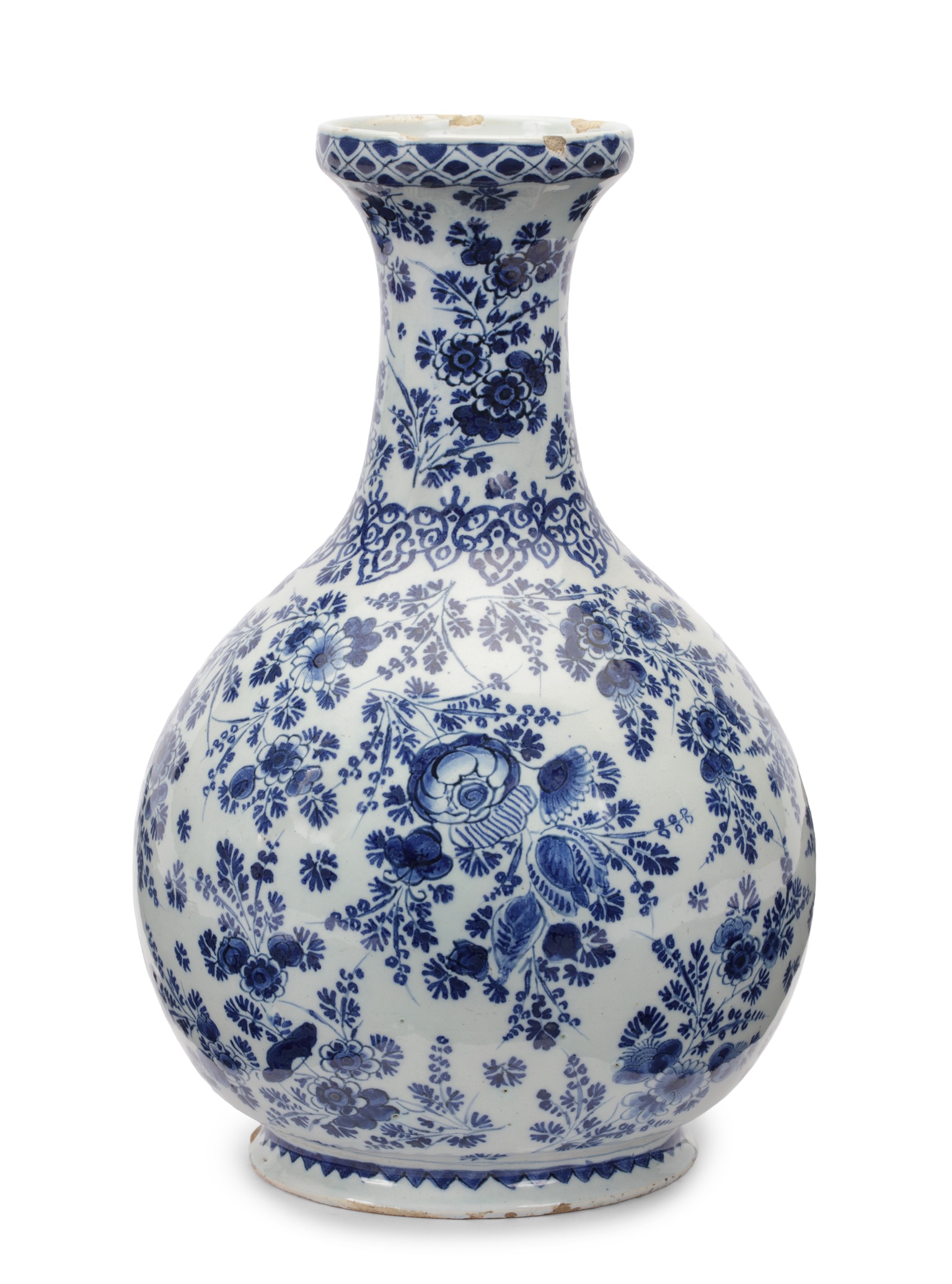
•D2625. Pear-Shaped Vase
Delft, circa 1710
Marked LVE 1 2 in blue for Lambertus van Eenhoorn, the owner of De Metaale Pot (The Metal Pot) factory from 1691 to 1721 or his widow Margaretha Teckmann from 1721 to 1724
DIMENSIONS
Height: 24 cm. (9.5 in.)
NOTE
This vase is a characteristic example of Delftware produced under Lambertus van Eenhoorn’s direction and illustrates with particular clarity the so-called millefleur decorative mode that became closely associated with his tenure. The form, with its broad, rounded body, gently tapering neck, and slightly flaring mouth, reflects a well-established Delft interpretation of East Asian bottle shapes, offering an expansive surface ideally suited to dense, all-over ornamentation.
The vase is decorated in blue with a continuous millefleur pattern, composed of small, freely dispersed flowering plants, leafy sprays, and delicate tendrils that appear to float across the surface without a dominant central motif. This manner of decoration creates an impression of abundance and visual movement, dissolving hierarchical organization in favor of rhythmic repetition. Unlike panelled or narrative schemes, the millefleur pattern emphasizes surface unity, transforming the vase into a coherent ornamental whole rather than a carrier of discrete pictorial scenes.
Van Eenhoorn’s period of management is widely recognized as one of technical refinement and stylistic confidence within Delftware production. The millefleur decoration seen here is emblematic of his factory’s output and reflects a deliberate aesthetic shift toward patterns that foreground decorative richness and painterly finesse over narrative content. Under Van Eenhoorn, Delft potters demonstrated exceptional control of cobalt pigment, achieving subtle tonal variation and fluid brushwork that animate even the smallest floral elements.
The millefleur motif itself has its origins in Chinese porcelain, where scattered floral designs were employed to evoke natural abundance and seasonal vitality. In Delft, however, the motif was reinterpreted through a distinctly European lens. While inspired by Asian prototypes, Delft millefleur patterns tend to be less symbolically prescriptive and more decorative in intent, responding to Western tastes for surface complexity and visual density. The result is not a direct imitation but a hybrid ornamental language that bridges Chinese inspiration and Dutch decorative sensibilities.
 CHINESE 阿伦森 WEBSITE