
Images on this website are licensed under a
Creative Commons Attribution-NoDerivs 3.0 Unported License.
OBJECT
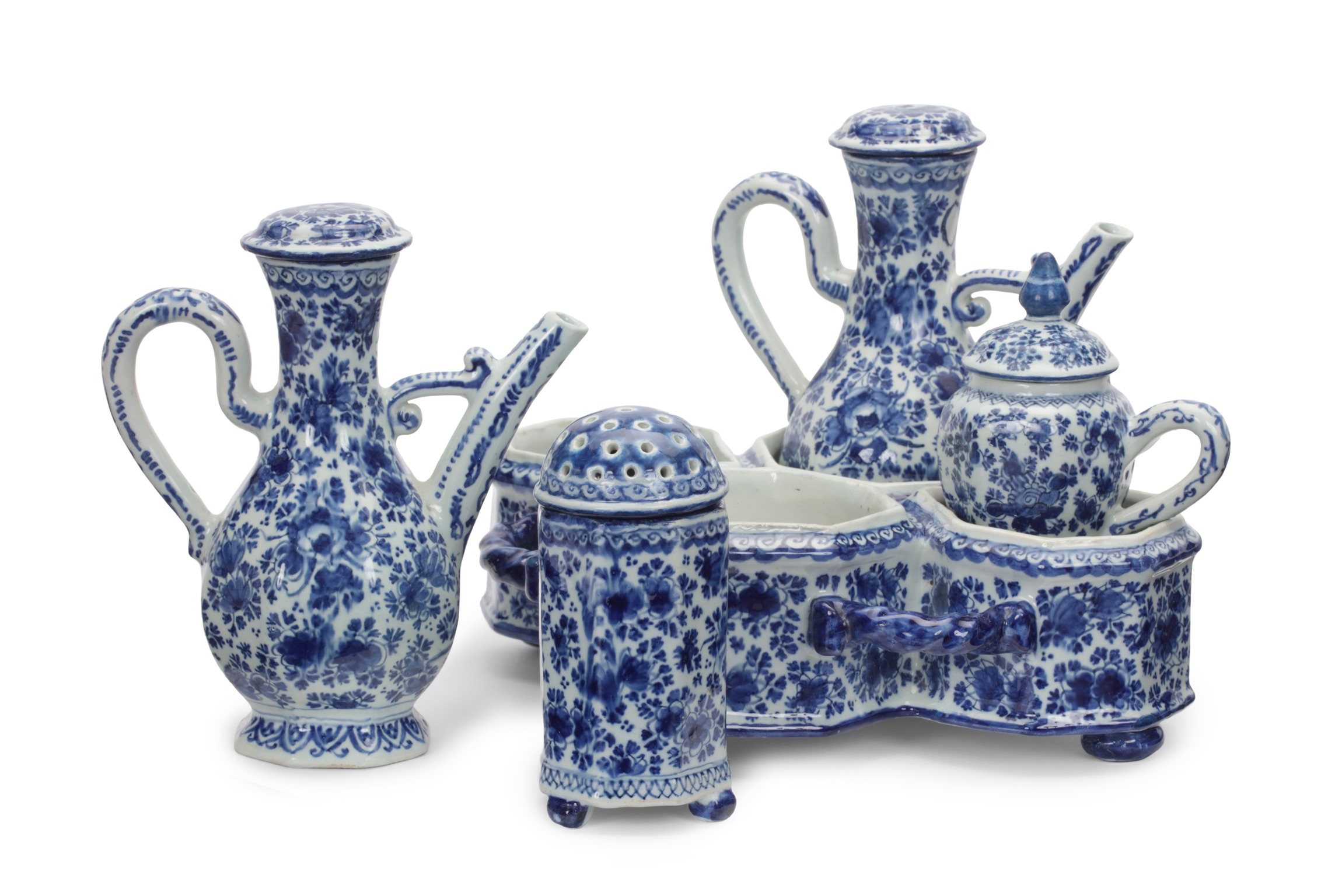
•D2624. Cruet Set
Delft, circa 1695
Marked IVB 24 in blue, attributed to Jan van der Burgh, meesterknecht at De Metaale Pot (The Metal Pot) factory from 1695 until 1697
DIMENSIONS
Height: 17 cm. (6.7 in.);
Width: 23.5 cm. (9.3 in.)
NOTE
This elaborate cruet set, comprising a ewer for vinegar, a ewer for oil, a salt or sugar cellar and a mustard pot, is attributed to Jan van der Burgh, meesterknecht at De Metaale Pot (The Metal Pot) from 1695 to 1697. During this period, the factory was owned by Lambertus van Eenhoorn, son of Wouter and brother of Samuel van Eenhoorn, who were both prominent Delftware manufacturers. Lambertus initially resisted a career in pottery, choosing instead a life of military service and extensive travel, which placed considerable financial strain on his family and resulted in restrictions on his inheritance. After a short period studying medicine at the University of Leiden, he returned to the Netherlands and eventually entered the porcelain trade. With support from his brother-in-law, Adrianus Kocx, he purchased De Metaale Pot in 1691 and soon became a leading Delft potter, known for aligning production with contemporary tastes and elevating the factory’s artistic reputation.
A notable number of Delftware objects marked LVE (for Lambertus van Eenhoorn) also bear additional initials and numbers, the meanings of which are not always clear. In this case, the initials IVB are believed to identify Jan van der Burgh himself. Van der Burgh passed the master potter’s examination of the Saint Luke’s Guild in 1695 and, on September 12 of that year, was appointed meesterknecht at De Metaale Pot. In seventeenth- and eighteenth-century Delftware factories, a meesterknecht held an important managerial and technical role, often supervising production and contributing directly to design and decoration.
While the LVE mark indicates production during Lambertus van Eenhoorn’s ownership of De Metaale Pot (1691–1721), the accompanying initials likely identify the actual maker, designer, or decorator of the piece. The presence of similar objects marked LVE and IVB, or even IVB alone, strongly suggests that Jan van der Burgh was directly involved in their creation. This attribution not only provides a more traceable provenance for the cruet set but also enriches our broader art historical understanding of the production of Delftware.
 CHINESE 阿伦森 WEBSITE