
Images on this website are licensed under a
Creative Commons Attribution-NoDerivs 3.0 Unported License.
OBJECT
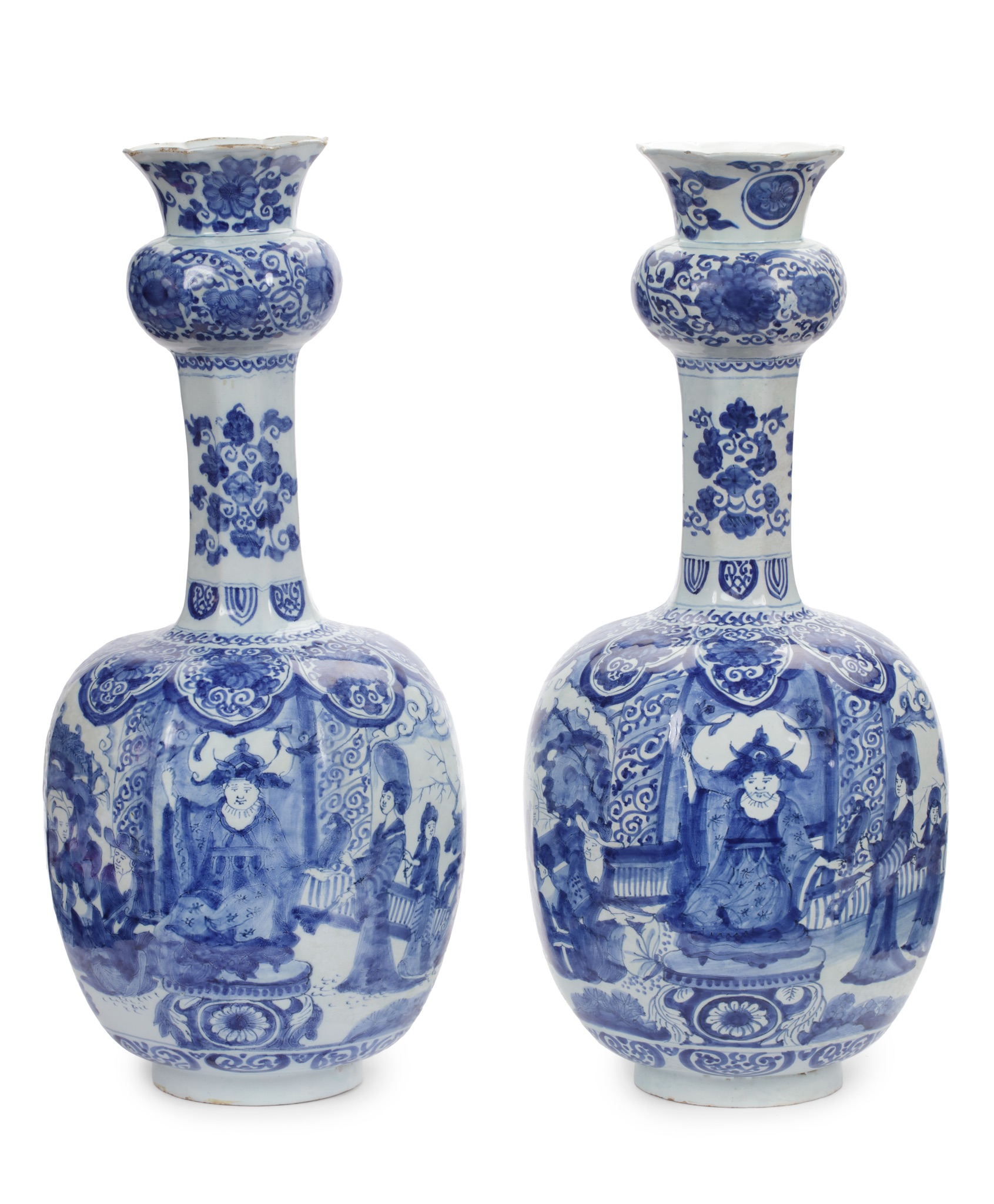
D2620. Pair of Large Bottle Vases
Delft, circa 1695
Both marked LVE and IVB in blue for Lambertus van Eenhoorn, the owner of De Metaale Pot (The Metal Pot) factory from 1691 to 1721 and the IVB mark attributed to Jan van der Burgh, meesterknecht at De Metaale Pot (The Metal Pot) factory from 1695 until 1697
DIMENSIONS
Heights: 52.7 cm.
(20.8 in.)
PROVENANCE
Private Collection, Virginia, USA;
Aronson Antiquairs, Amsterdam
LITERATURE
Aronson 2009, pp. 32-33, no. 16
NOTE
This pair of large octagonal bottle vases exemplifies the sophisticated use of European graphic sources in Delftware decoration during the final quarter of the seventeenth century. While Chinese porcelain offered an important stimulus for Delft painters, complex continuous scenes of this type were often assembled with the aid of prints, which provided transferable figure groups, landscape elements, and compositional frameworks comparable to those admired on Chinese Transitional wares.
Across the faceted bodies the decoration unfolds as a continuous narrative. A dignitary is shown enthroned between three men seated to his right, near a table arranged with various vessels. To his left, a lady approaches, accompanied by an attendant bearing a fan; she turns her head to glance back toward a seated and a standing figure by a river, with a small pavilion visible on the far bank. The careful staging of these groups, with secondary episodes set at the margins, suggests a print-derived compositional logic rather than a direct ceramic prototype.
The imagery appears to be inspired by seventeenth-century European travel literature on China, such as the illustrated publications of Johan Nieuhof and Olfert Dapper, or related travelogues and print series that circulated widely in the Dutch Republic. These sources offered Delft painters a rich visual repertory of imagined “Chinese” figure types, courtly scenes, and landscape motifs, which could be adapted and recombined to create complex narrative compositions on ceramic surfaces.
Rather than copying a single identifiable print, Delft painters frequently drew upon multiple graphic sources, selectively borrowing and reconfiguring motifs to suit the format of the object. Prints and drawings could be transferred onto the unfired tin glaze using stencils, papers pricked along the outlines, through which charcoal was dabbed to establish the basic contours before painting. Such practices underscore the interpretative nature of Delft chinoiserie, in which Asian subject matter was filtered through European print culture and artistic conventions, resulting in scenes evocative of China without claiming documentary accuracy.
 CHINESE 阿伦森 WEBSITE