

Images on this website are licensed under a
Creative Commons Attribution-NoDerivs 3.0 Unported License.
OBJECT
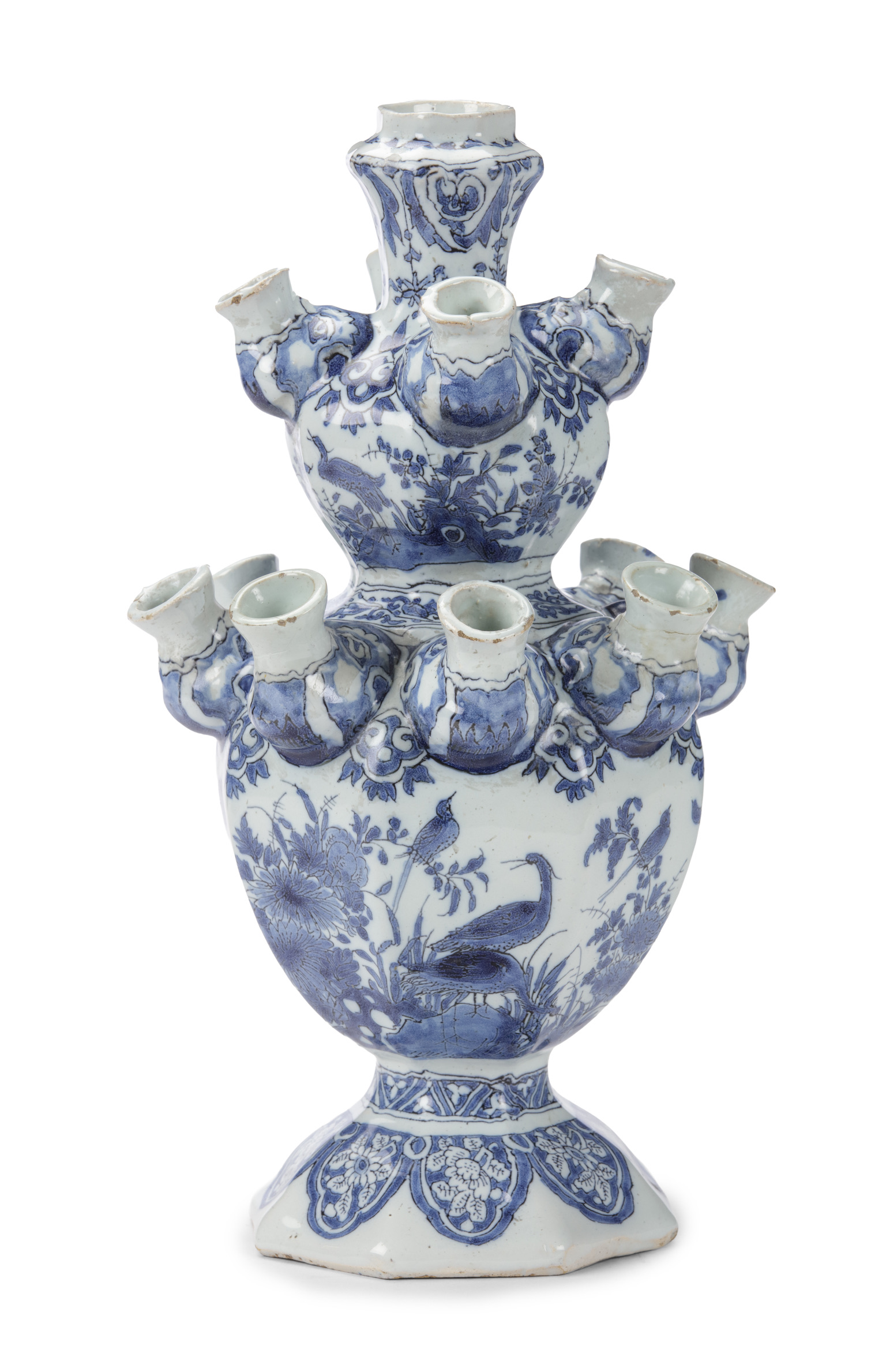
•D2619. Spherical Flower Vase
Delft, circa 1695
Marked AK in blue for Adrianus Kocx, the owner of De Grieksche A (The Greek A) factory from 1686 to 1701
DIMENSIONS
Height 28 cm. (11 in.)
NOTE
This flower vase represents an early and ambitious phase in the development of multi-spouted flower holders in Delft, produced around 1690 at the factory De Grieksche A under the direction of Adrianus Kocx. Vases of this type belong to the formative generation of Delft flower holders, when potters were experimenting with complex architectural forms designed to accommodate the fashionable display of cut flowers within domestic interiors.
The vase is constructed from stacked, bulbous elements rising from a faceted foot, with each tier pierced by short, projecting spouts arranged radially around the body and culminating in a central neck. This tiered construction reflects a modular approach to ceramic design, in which separately thrown and molded components were assembled into a unified sculptural form. Such structures allowed for the placement of individual flower stems at varying heights, creating a carefully orchestrated floral arrangement that emphasized symmetry and verticality.
The imagery draws upon Chinese decorative sources, mediated through late seventeenth-century European interpretations of porcelain decoration. The integration of birds and flowering plants within a continuous pictorial field enhances the organic relationship between the painted surface and the vase’s intended function as a flower holder.
Flower vases of this complexity emerged in Delft around the final decades of the seventeenth century, closely associated with the production of De Grieksche A, one of the most innovative and technically accomplished factories of the period. Under Adrianus Kocx, the factory played a central role in refining both the form and decoration of flower holders, responding to the growing demand for elaborate display objects that reflected contemporary tastes for symmetry, ornament, and botanical abundance.
 CHINESE 阿伦森 WEBSITE