
Images on this website are licensed under a
Creative Commons Attribution-NoDerivs 3.0 Unported License.
OBJECT
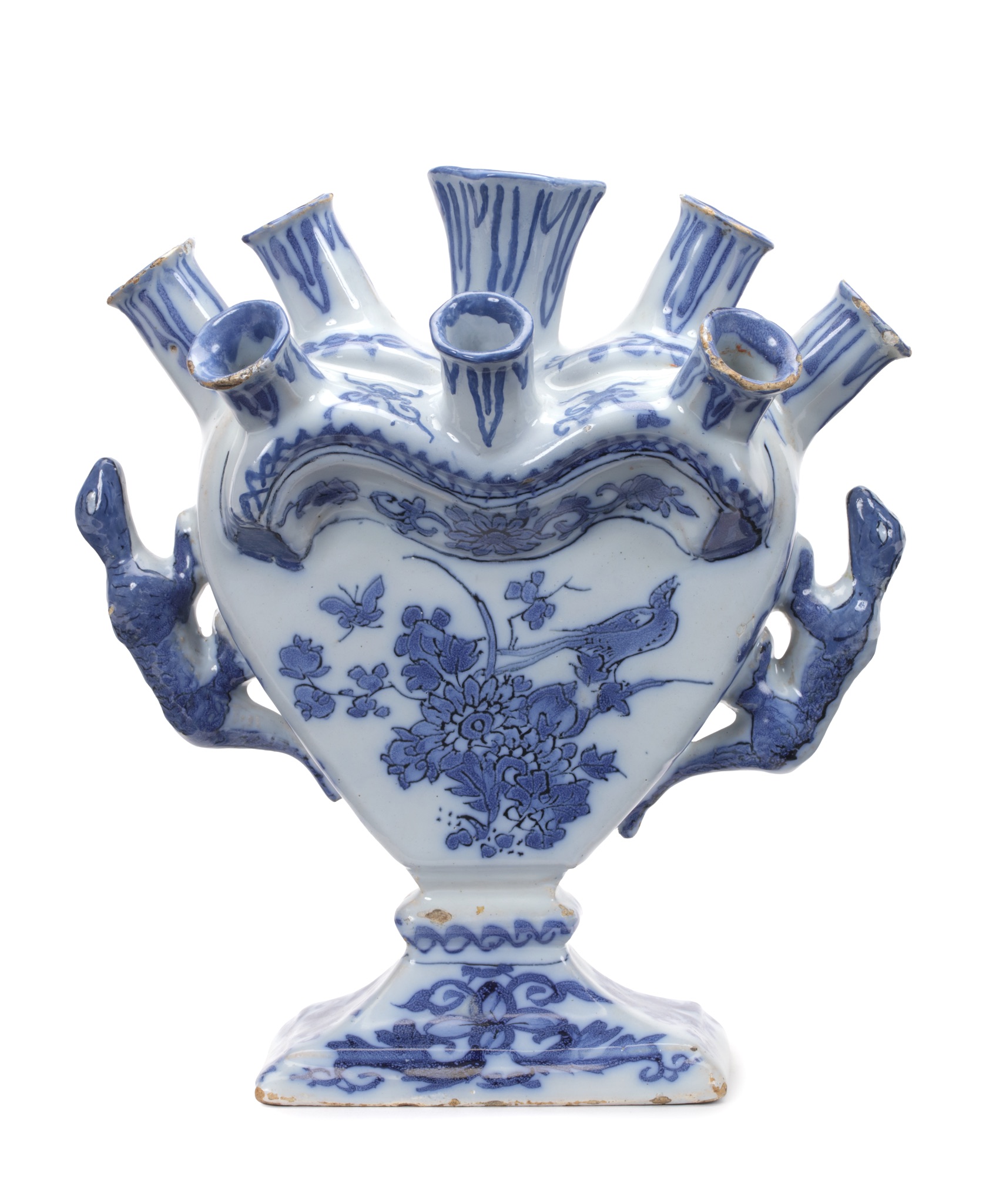
D2618. Fan-Shaped Flower Vase
Delft, circa 1690
Unidentifiably marked and numbered with a dashed O 10, attributed to Adrianus Kocx, the owner of De Grieksche A (The Greek A) factory from 1686 to 1701
DIMENSIONS
Height 20.5 cm. (8 in.)
PROVENANCE
Belgian private collection;
Salomon Stodel, Amsterdam;
Collection Mrs. Richard Ernst;
Sotheby’s New York, 31 October 1981, lot no. 26
NOTE
This exceptionally rare Delft flower vase belongs to the celebrated tradition of multi-spouted flower holders produced in Delft from the 1680s until approximately 1740. Such vases were conceived to accommodate fashionable floral displays in which individual stems could be arranged separately, reflecting contemporary horticultural interests and the growing prestige of cut flowers within elite interiors of the Dutch Republic.
The earliest Delft flower vases of this type were relatively restrained in form. Known as quintel vases, they consisted of a compact body surmounted by a single fan-shaped row of five tubular spouts. These early examples, introduced in the late seventeenth century, already demonstrate the ingenuity of Delft potters in adapting ceramic forms to specific domestic uses. As demand increased and competition between factories intensified, the basic model was progressively elaborated. Additional rows of spouts were introduced, the bodies became more sculptural, and the silhouettes evolved into oval or heart-shaped profiles that offered greater visual impact and complexity.
The present vase represents an advanced stage in this development. It is distinguished by its double row of spouts, a feature encountered only rarely and indicative of experimental design within the Delft industry. The body has been transformed into a sculptural, heart-shaped form supported by a pedestal foot, and is flanked by striking salamander-shaped handles, a motif documented in the output of both De Metaale Pot (The Metal Pot) and De Grieksche A (The Greek A) factories.
The salamander-shaped handles contribute an additional symbolic layer. In seventeenth-century emblematic thought, the salamander was believed to possess the ability to live in or withstand fire, making it a potent symbol of resilience, purity, and incorruptibility. The incorporation of such creatures on Delft flower vases may therefore be read not merely as decorative whimsy, but as an allusion to desirable moral and intellectual qualities, subtly reinforcing the vase’s status as a prestigious and meaningful object.
 CHINESE 阿伦森 WEBSITE