
Images on this website are licensed under a
Creative Commons Attribution-NoDerivs 3.0 Unported License.
OBJECT
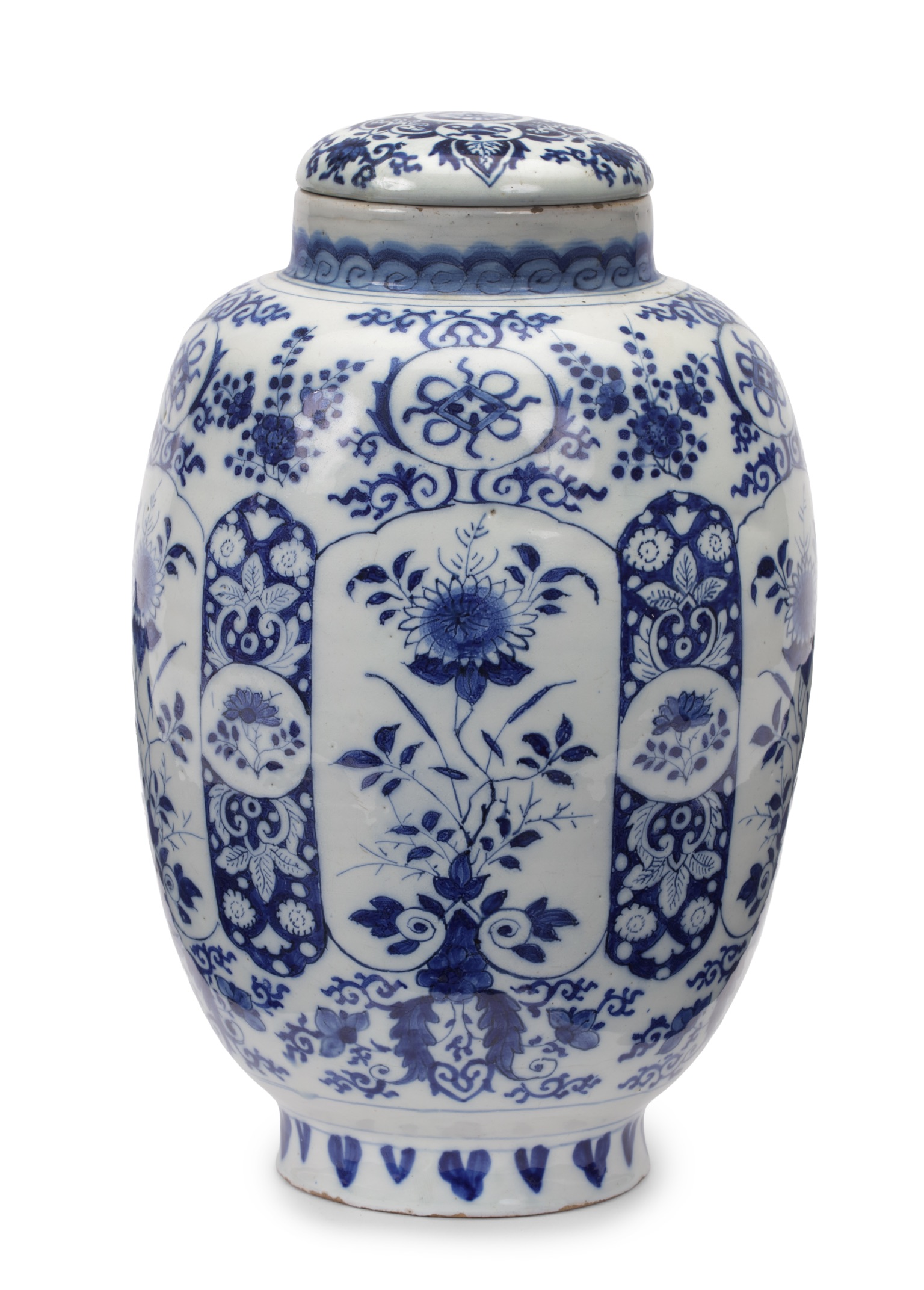
•D2617. Ovoid Jar
Delft, circa 1690
Marked AK No 8 in blue for Adrianus Kocx, the owner of De Grieksche A (The Greek A) factory from 1686 to 1701
DIMENSIONS
Height: 24.5 cm. (9.7 in.)
NOTE
Covered ceramic vessels of varying shapes and styles became known in the Netherlands as gemberpotten, or ginger jars. The earliest documented use of this term appears in 1635 in Dutch ship inventories, where such jars are listed among transported goods, a usage discussed by Grasskamp and Wu (Vormen uit Vuur 232, 2016, p. 67). Although the name suggests a specific association with ginger, these containers were used far more broadly, holding items such as dried fruits, aromatic spices, and other valuable commodities.
Within Europe, lidded jars of this type gradually evolved from strictly utilitarian storage vessels into decorative objects appreciated for their form and painted ornament. Nonetheless, many examples undoubtedly continued to serve practical household functions alongside their aesthetic appeal.
This notably slender jar reflects the influence of seventeenth-century Transitional Chinese porcelain, whose elegant silhouettes and restrained decoration were widely admired in the Dutch Republic. Comparable forms are known from the Hatcher cargo, a mid-seventeenth-century shipwreck that yielded a significant group of Transitional porcelain and provides important evidence for the models that inspired early Delftware production.
 CHINESE 阿伦森 WEBSITE