
Images on this website are licensed under a
Creative Commons Attribution-NoDerivs 3.0 Unported License.
OBJECT
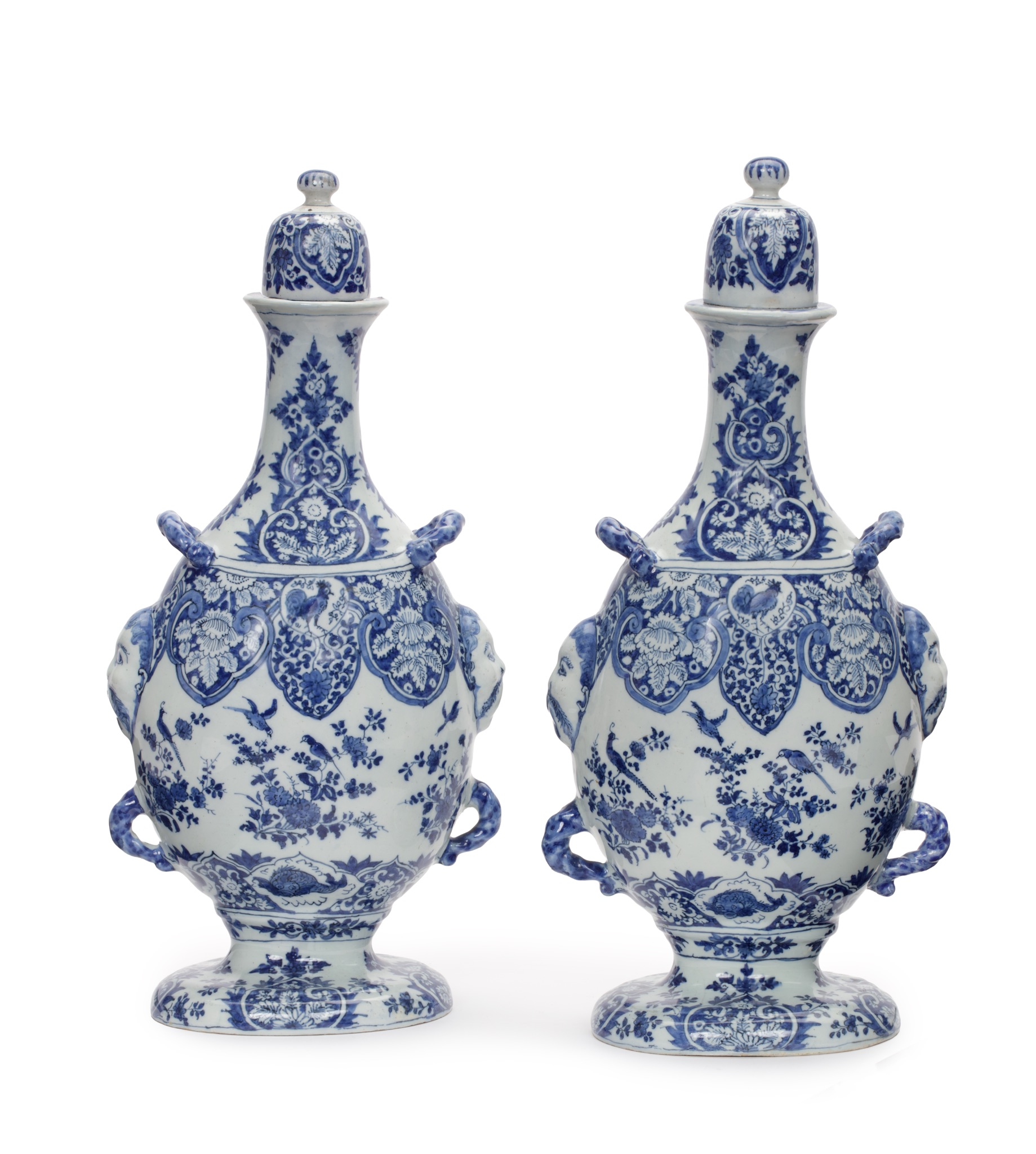
•D2616. Pair of Pilgrim Flasks
Delft, circa 1690
Both marked AK in blue for Adrianus Kocx, owner of De Grieksche A (The Greek A) factory from 1686 to 1701, and each further accompanied by a distinct figurative mark corresponding to its cover.
DIMENSIONS
Heights: 29 cm. (11.4 in.) and 28.8 cm. (11.3 in.)
PROVENANCE
French Private Collection, Paris
NOTE
The form of the pilgrim bottle has a long and cross-cultural history. In the West, it can be traced to Roman flasks carried by travelers, while in the East it appears in seventh-century Chinese examples, often in ceramics or metalwork. Over the centuries, the form was adapted in a remarkable variety of materials, earthenware, porcelain, silver, glass, and even leather, its flattened, rounded body and narrow neck making it practical for transport. By the seventeenth century, however, many pilgrim bottles, such as this finely painted Delft pair, were conceived not as functional vessels for travel, but as highly ornamental pieces for display.
The Delft potters of the late seventeenth and early eighteenth centuries were well aware of the prestige attached to silver pilgrim bottles. In that period, such vessels were considered among the most impressive elements of a royal silver buffet, their elegant symmetry and broad surfaces lending themselves to elaborate decoration. Some were presented as diplomatic or noble gifts, embodying wealth, status, and skilled craftsmanship. Delft potters adapted these luxury metal prototypes into tin-glazed earthenware, translating the silversmith’s sculptural form into a ceramic medium while enriching it with colorful painted ornament derived from Chinese porcelain or European baroque motifs.
In the Dutch Republic, decorative pilgrim bottles often occupied pride of place in the home, either as part of a garniture on a mantel or cabinet, or arranged symmetrically in pairs. While functional versions were still produced in silver and leather for actual travel, Delftware examples like this pair served a purely aesthetic purpose, reflecting both the global inspirations and the technical mastery of the Delft factories.
 CHINESE 阿伦森 WEBSITE