
Images on this website are licensed under a
Creative Commons Attribution-NoDerivs 3.0 Unported License.
OBJECT
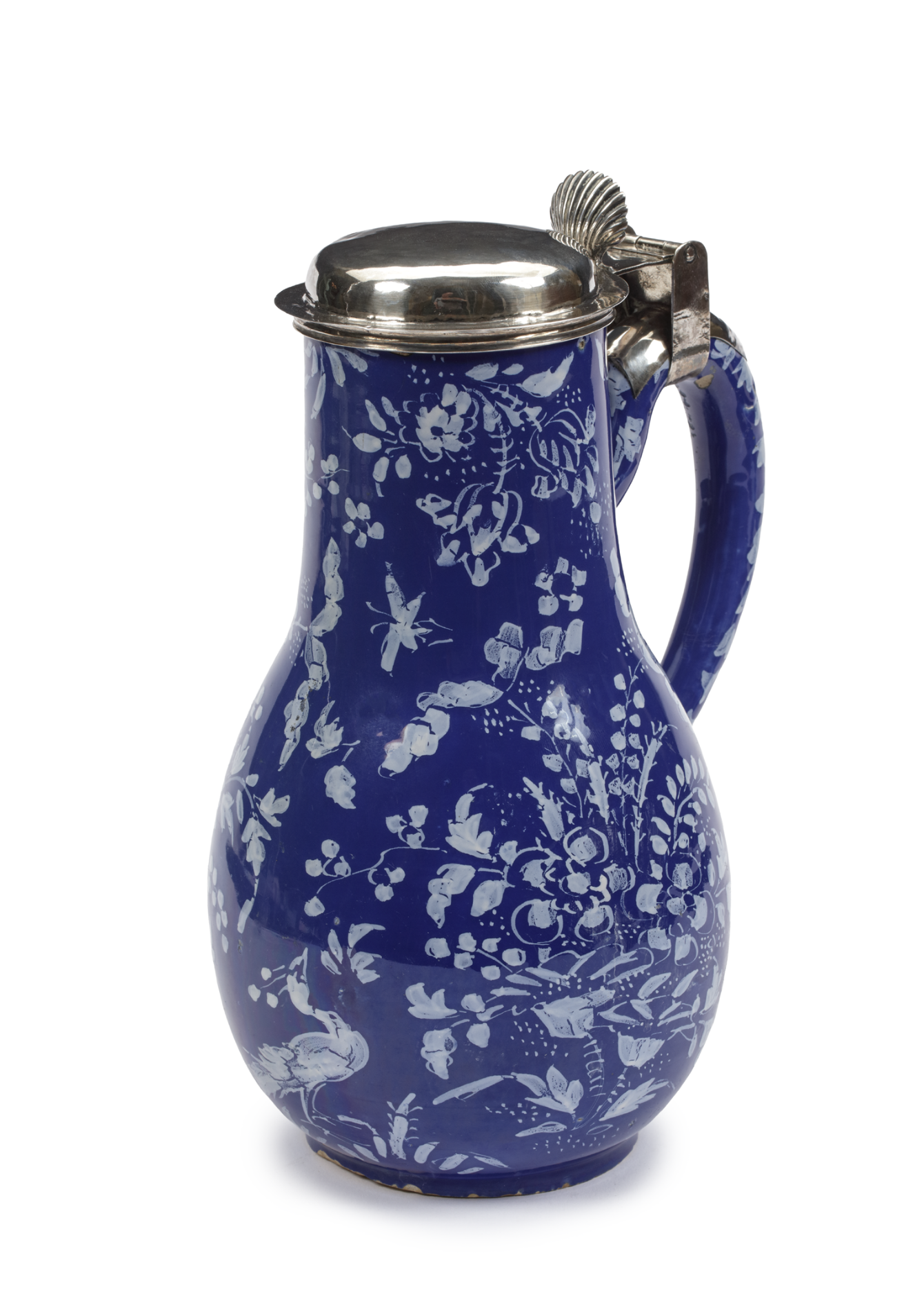
D2615. Persian Blue Tankard
Delft, circa 1685
Marked D – PAW 2 in white for De Paauw (The Peacock) factory
The silver is marked with the maker’s mark of Wierick III Somers, together with the city hallmark of Antwerp and the year letter ‘V’ for 1676–1677.
DIMENSIONS
Height: 21 cm. (8.3 in.)
PROVENANCE
Sold at Christies, Laren, 24 October 1979 as lot 2808;
A.Vromen Jr. Collection, Doetinchem
LITERATURE
”Delfts Aardewerk,” Jonkvrouwe Dr. C. H. De Jonge, Collectie A. Vromen Jr. in Vrienden van de Nederlandse Ceramiek, 1967, no. 48, p. 19, ill. 16;
Morley-Fletcher and Mcllroy, p. 214.
NOTE
Both Delft and English potters drew inspiration from the striking blue, white, and yellow glazed wares produced in Nevers, France, between circa 1660 and 1680, commonly referred to as bleu persan or bleu de Perse. These Nevers wares, characterized by opaque blue or yellow grounds enlivened with lace-like white decoration, were themselves the result of cross-cultural exchange. French faience makers in Nevers had learned the technique of colored grounds from Italian potters active in the city, a practice related to the Italian berettino tradition and subsequently adapted into a distinctly French idiom.
The so-called “Persian blue” color scheme ultimately derives from Iranian ceramic workshops, which imitated Middle Eastern prototypes and disseminated a visual language of deep blue grounds populated by stylized flora, water birds, lotuses, and peacocks. This aesthetic entered the Delftware repertoire around 1680, although surviving examples are rare, reflecting both the technical challenges of producing such wares and their limited period of popularity. Delft potters translated the Nevers models into tin-glazed earthenware, achieving a comparable depth of color while integrating motifs that resonated with contemporary European taste for the exotic and the Asian-inspired.
Within Delft, De Paauw (The Peacock) factory emerged as the principal innovator in this field. Under the leadership of David Kam, the factory perfected the Persian blue technique, producing wares that closely echoed the richness and visual impact of the original Nevers ceramics, while developing a distinctive decorative vocabulary centered on floral motifs and emblematic birds such as the peacock. De Paauw’s production of Persian blue wares reached its zenith in the late seventeenth century, before the factory adapted to shifting market demands around 1700 by embracing blue-and-white styles inspired by transitional and Kangxi porcelain.
 CHINESE 阿伦森 WEBSITE