
Images on this website are licensed under a
Creative Commons Attribution-NoDerivs 3.0 Unported License.
OBJECT
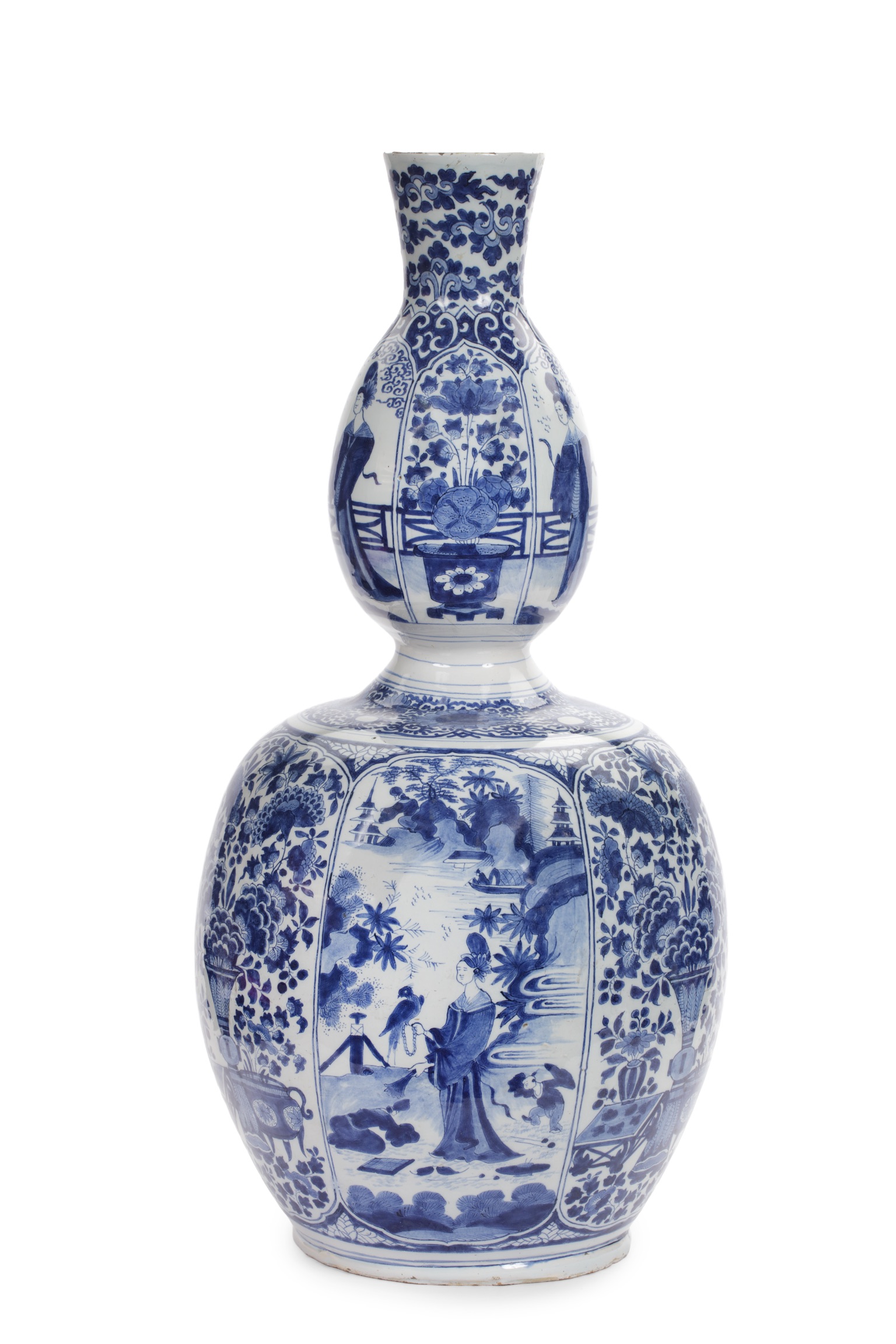
D2614. Massive Double-Gourd-Shaped Vase
Delft, circa 1690
Marked GK in blue for Gerrit Pietersz. Kam, owner of the Drie Posteleyne Astonne (The Three Porcelain Ash- Barrels) factory from 1679 to 1700
DIMENSIONS
Height: 61 cm. (24 in.)
NOTE
This double-gourd–shaped vase is painted on the spherical body with six vertical panels alternately depicting elongated female figures, known in Dutch collecting tradition as Lange Lijs (“Long Eliza”), and still-life panels showing a vase filled with an intricate bouquet. In the figural panels, Lange Lijs appears holding a fan and flowers within a garden or landscaped setting; the same visual program is repeated on the bulbous, tapering neck, creating a coherent iconographic cycle across both lobes of the form.
The Lange Lijs type emerged in the Dutch Republic through sustained exposure to Chinese porcelain from around 1600 onward. Chinese blue and white wares were initially prized in Europe largely for their visual sophistication and “exotic” appeal, and Delft potters, responding to market demand, translated these imported models into tin-glazed earthenware. In this process, Chinese narrative figures were frequently detached from their original pictorial contexts and redeployed as ornamental units, arranged in panels or repeating sequences to suit Western expectations of symmetry and pattern. The result is a telling example of early modern cultural transfer: motifs embedded in Chinese visual culture, where figural attributes and surrounding objects often carried legible symbolic or narrative meaning, were reinterpreted in Delft as emblems of elegance and refined foreignness.
The Dutch name Lange Lijs reflects this reception history. “Lijs,” a diminutive of Elizabeth, had established associations in Dutch usage (from the sixteenth century onward) with a “tall woman” (and also, more broadly, a “slow person”). Because the Chinese women on porcelain were typically rendered as slender and elongated, the term gravitated toward the former meaning, becoming a convenient label for these graceful figures as they circulated in Dutch homes and collections. On Delftware such as the present vase, the emphasis lies on silhouette, costume, and compositional poise, while the original identities of the women (which in Chinese contexts could refer to specific historical or mythological figures, recognizable through attributes) were generally not understood by European consumers. Even so, the persistence of flowers, fans, and attendant garden settings preserves key visual cues from the porcelain prototypes and underscores the role of Delftware as a mediator between Chinese pictorial traditions and Dutch decorative taste.
 CHINESE 阿伦森 WEBSITE