
Images on this website are licensed under a
Creative Commons Attribution-NoDerivs 3.0 Unported License.
OBJECT
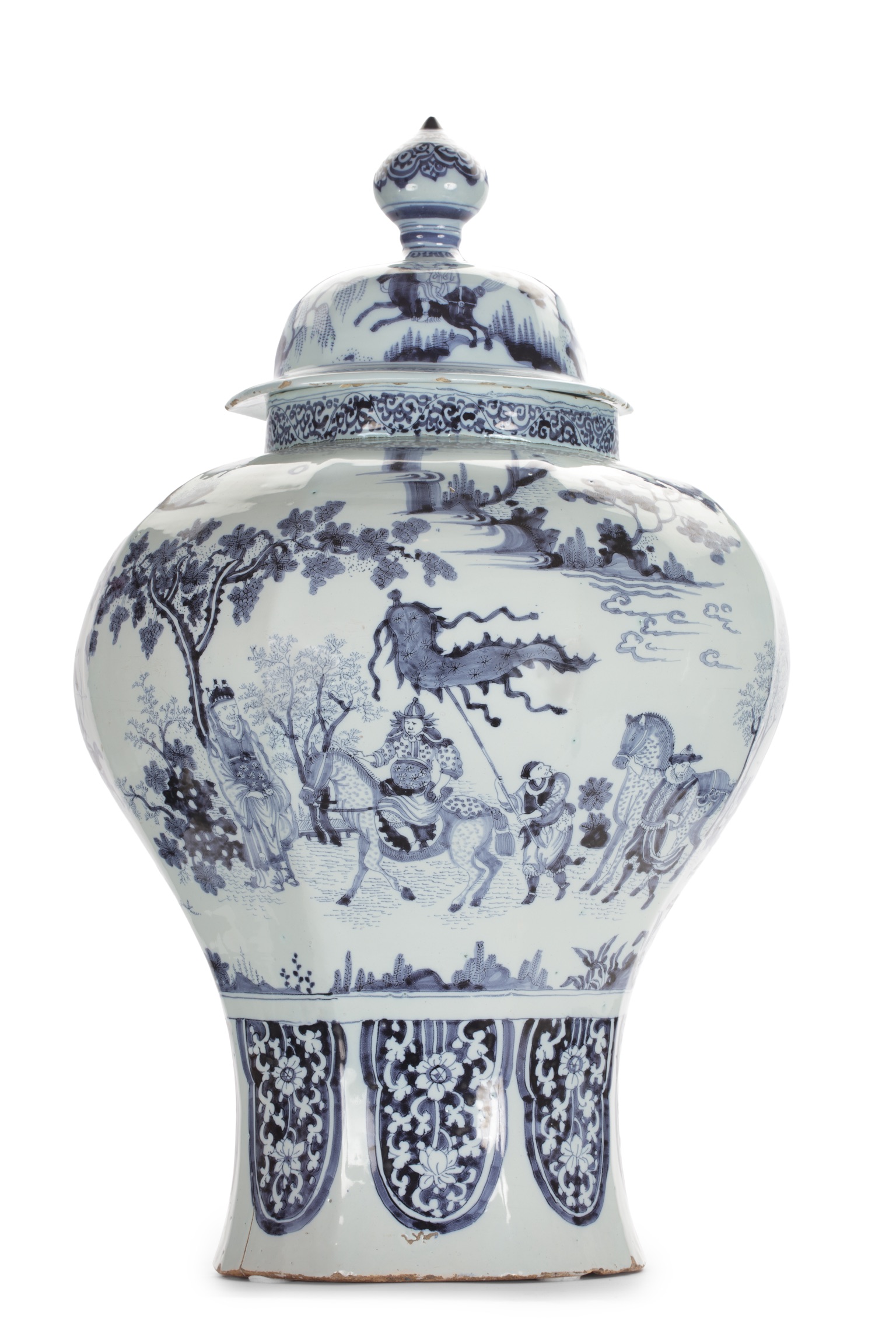
D2612. Large Vase
Delft, circa 1690
Marked with numeral 2 in blue
DIMENSIONS
Height: 64 cm. (25.2 in.)
NOTE
Scenes depicting dignitaries, equestrian attendants, and courtly processions occupy a prominent place in the visual language of chinoiserie Delftware produced in the Netherlands, particularly in the late seventeenth century, when artistic depictions of imagined Chinese courtly life became popular among European collectors and patrons.
Rather than offering faithful depictions of Chinese life, these compositions represent European interpretations of East Asian motifs, often assembled from a variety of indirect sources. These compositions were inspired by a blend of Chinese porcelain motifs, European engravings after Asian subjects, and imaginative reconstructions filtered through the lens of European taste and “exoticism.”
Within this framework, processional and courtly scenes offered a sense of grandeur and refinement. Dignitaries are shown mounted on horseback, followed by attendants bearing parasols, fans, or scrolls, symbols of authority, service, and elite culture. The depiction of Chinese dignitaries reflects a European fantasy of hierarchical order in an imagined “China.” Other figures are depicted seated under pavilions or canopies, engaged in conversation, music, or scholarly pursuits, evoking ideals of cultured leisure and suggest scholarly or philosophical gatherings, while mounted warriors introduce elements of martial virtue and ceremonial procession. The surrounding landscapes, populated with prunus trees and rocks, create a harmonious backdrop, not meant to represent real geographies, but rather a constructed image of distant sophistication.
Delftware painters adapted these motifs with a distinctly Dutch aesthetic sensibility. On Delftware, such chinoiserie scenes were often rendered as continuous compositions, encircling the surface of vases. These chinoiserie fantasies reflected contemporary European tastes for luxury, refinement, and courtly elegance, shaped by expanding global trade and a growing fascination with East Asian material culture. Such imagery often conveyed an imagined world that was perceived as cultivated, distant, and mysterious, aligning with broader cultural currents in early modern Europe that aestheticized foreign cultures through selective interpretation and artistic adaptation.
 CHINESE 阿伦森 WEBSITE