
Images on this website are licensed under a
Creative Commons Attribution-NoDerivs 3.0 Unported License.
OBJECT
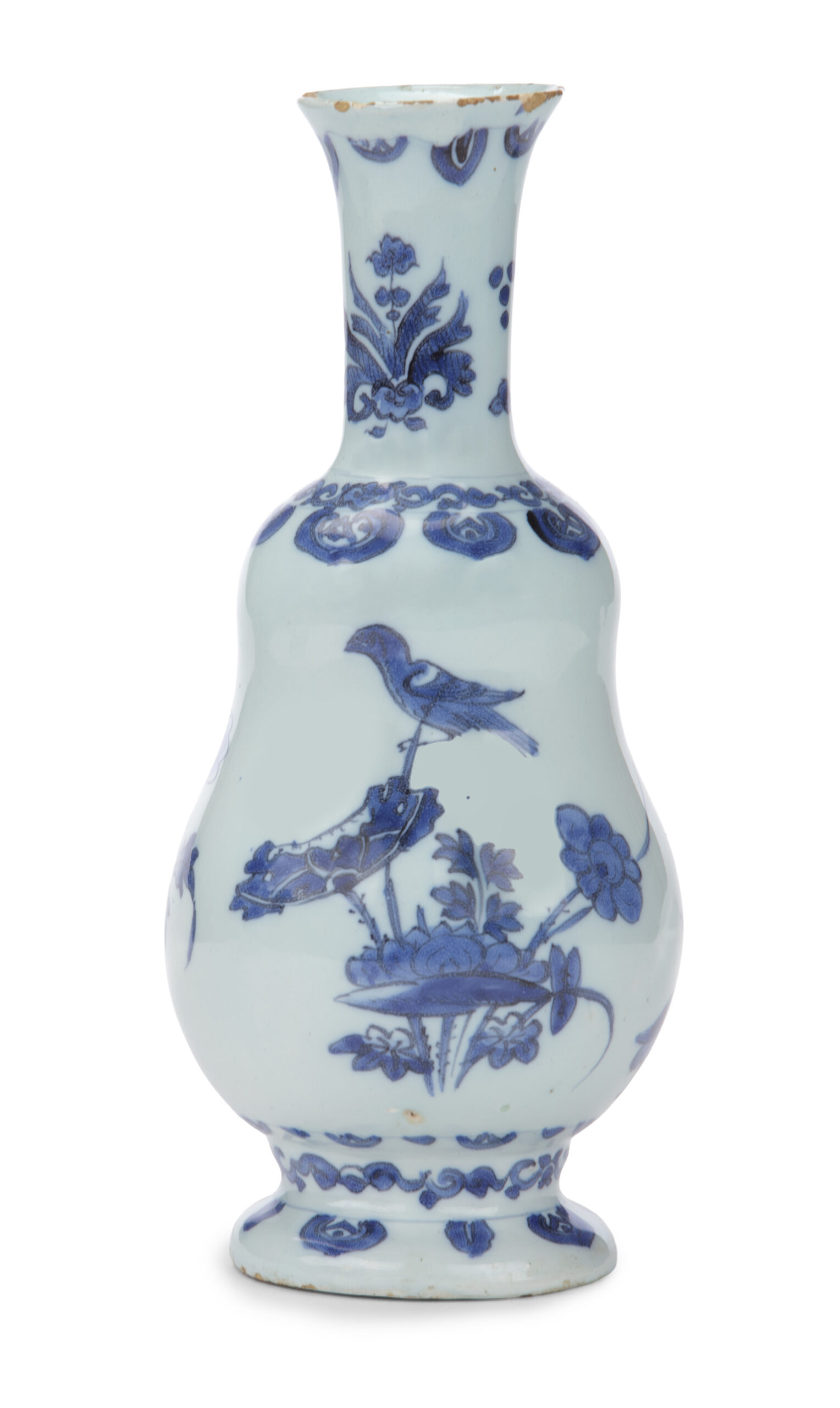
D2610. Pear-Shaped Vase
Delft, circa 1685
Marked LC in blue for Lambertus Cleffius, the owner of De Metaale Pot (The Metal Pot) factory from 1679 to 1691, and with a molded numeral VIII
DIMENSIONS
Height: 23.3 cm. (9.2 in.)
PROVENANCE
Collection B. Vervoort, Heerlen,
The Netherlands
NOTE
By the second half of the seventeenth century, Delftware had reached the height of its success, and the number of factories expanded rapidly. While the trade had long been dominated by established craft families, its profitability soon attracted wealthy investors. One was Willem Cleffius, originally from Cologne, who settled in Amsterdam as a merchant. In 1632 he married Marguerite Lambrechtsdr. Cruyck, daughter of the owner of De Dissel (The Pole) factory and sister of Wouter van Eenhoorn, founder of De Grieksche A. Well connected within the industry, Willem entered the Delftware trade in 1662 as co-owner of De Paauw, and in 1670 purchased De Metaale Pot from the Dutch East India Company.
Willem’s son Lambertus Cleffius joined the factory immediately. Registered with the Guild of Saint Luke since 1667, he likely managed daily operations while his father oversaw the business. After his marriage in 1672 he became a shareholder, and in 1679, upon Willem’s death, he assumed full ownership. Like his father, he invested in additional potteries such as De Witte Ster, helping build a network of family-run enterprises that strongly influenced the Delftware trade. His clientele was international, and in the 1680s he received the prestigious commission for a large dinner service for Wenzel Ferdinand, Prince Lobkowicz of Bilina, the earliest and largest known Delftware service.
Highly regarded for both craftsmanship and business acumen, Cleffius represented Delft potters in 1684 negotiations with England to lift a long-standing trade embargo. He also played a major role in the introduction of registered maker’s marks: after publicly claiming in 1678 to have invented red stoneware teapots and discovered the secret of porcelain, a dispute with rival potters prompted the States of Holland to mandate registered marks to prevent counterfeiting. His interlaced L.C. mark remains crucial for scholars.
Cleffius preferred a restrained decorative style, marked by balanced compositions and a fine trek line for detailing, as seen on an octagonal triple-gourd vase and other notable pieces. At his death in 1691, his estate included paintings, Chinese porcelain, and Delftware, reflecting his wealth and taste. Shortly thereafter, De Metaale Pot passed to his cousin Lambertus van Eenhoorn, keeping the factory within a leading Delftware dynasty.
 CHINESE 阿伦森 WEBSITE