
Images on this website are licensed under a
Creative Commons Attribution-NoDerivs 3.0 Unported License.
OBJECT
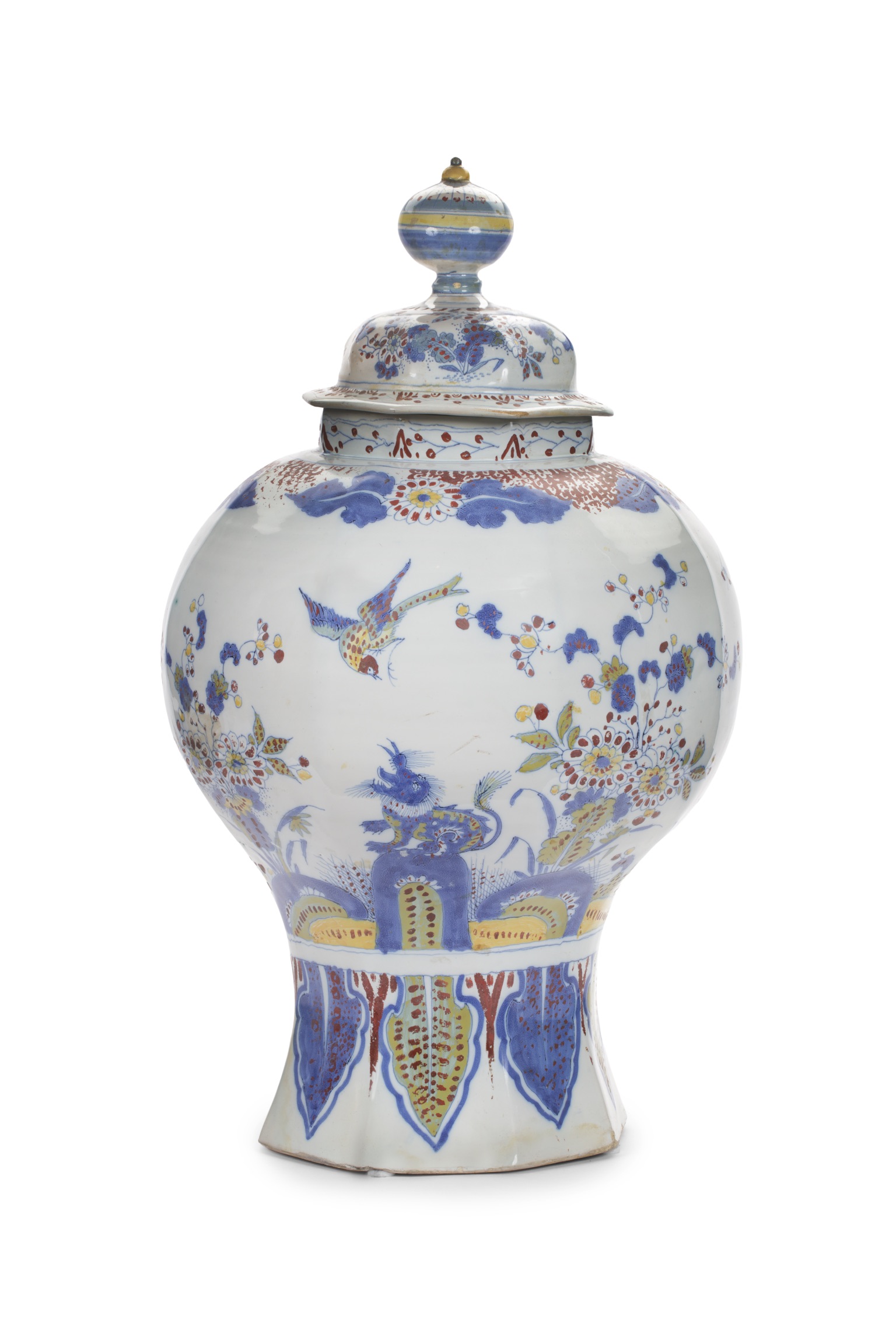
D2605. Large Vase and Cover
Delft, circa 1670
Attributed to De Paauw (The Peacock) factory
DIMENSIONS
Height 55.5 cm. (21.9 in.)
NOTE
The vibrant polychrome palette seen on the present vase was the result of complex and highly skilled techniques, developed and refined over many years. Not all colors could be applied and fixed in a single firing; instead, pieces often underwent multiple kiln firings, each tailored to specific types of pigment. The grand feu colors on this vase, blue, green, and yellow, were applied before the glaze firing and required high temperatures of approximately 1000°C. The red color on this vases is a so-called cold-painted decoration, which was as the term suggests applied without firing at all, using lacquer-based paints that adhered to the glazed surface. Red was initially a challenging color for Delftware painters to master. The metal oxides required to produce red hues could not withstand the high firing temperatures used in the production of tin-glazed earthenware. In search of solutions, Delft artists looked to Middle Eastern and Italian traditions, adopting the use of a thin layer of diluted red ochre as a surface application. This pigment, known as ‘rode bolus’ (red bolus) or ‘Armeense zegelaarde’ (Armenian seal-earth), was not fired into the glaze but applied as a paint-like substance after the primary firing. The exact hue of red produced by this method varied depending on the geographic origin and mineral content of the ochre. For example, Terra di Pozzuoli contained only 20% iron oxide, resulting in a lighter red, while Spanish and Persian red ochres could reach up to 95% iron oxide, yielding much deeper and more saturated tones. The final color was thus determined by both iron content and natural impurities in the raw material. The cold-painting technique, in which red lacquer paint was applied after the vessel had already been fired with its blue, green, and yellow decoration, is relatively rare. Many painters continued to rely on the traditional red-ochre method; moreover, lacquered red adhered poorly to the glazed surface and was therefore particularly susceptible to wear. As a result, few well-preserved examples of true cold-painted red decoration survive. This type of polychrome decoration was especially favored at De Paauw (The Peacock) factory, where it was applied to a wide range of objects, including plates, vases, posset pots, and modeled animal and human figures. On the basis of the decorative execution and color palette, the present vase can be attributed to De Paauw factory.
 CHINESE 阿伦森 WEBSITE