

Images on this website are licensed under a
Creative Commons Attribution-NoDerivs 3.0 Unported License.
OBJECT
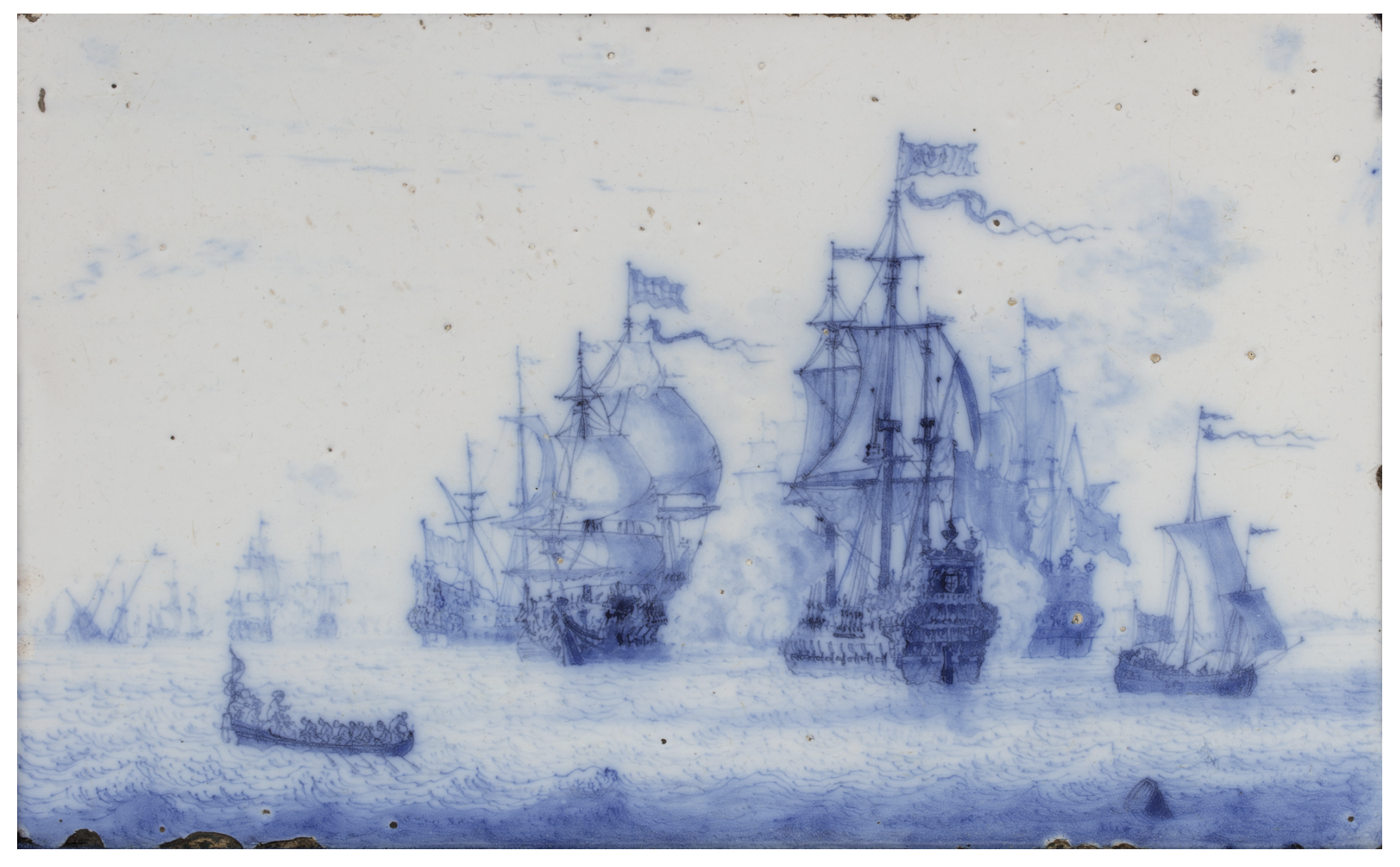
•D2603. Marine Plaque
Delft, circa 1660
DIMENSIONS
Length 24.2 cm. (9.5 in.);
Height 14.8 cm. (5.8. in.)
PROVENANCE
Dutch Private Collection, Maastricht;
Aronson Antiquairs, Amsterdam, 2002
NOTE
This Delftware marine plaque exemplifies the close relationship between seventeenth-century Dutch ceramics and contemporary marine painting. Decorated in cobalt blue on a white tin-glazed ground, it depicts a naval engagement with clustered warships, billowing sails, and an animated sea, reflecting the visual language of Willem van de Velde the Younger (1633–1707), the foremost chronicler of Dutch naval power. The scene is likely inspired by the Second Anglo-Dutch War (1665– 1667), a conflict that profoundly shaped Dutch visual culture. Marine battles were widely commemorated in paintings, drawings, and prints, serving both as historical records and expressions of national identity. The legible rendering of ships, rigging, and flags suggests familiarity with Van de Velde’s battle scenes, admired for their technical accuracy and documentary precision. While the rise of Delftware is closely associated with global trade and the import of Chinese porcelain, the broader cultural resonance of maritime life in the Dutch Republic is less often emphasized. Nautical themes permeated Dutch visual culture, extending beyond merchant and seafaring circles into aspects of everyday life and the decorative arts. Despite the Netherlands’ maritime identity, such imagery remains relatively rare on Delftware, with notable exceptions such as the present plaque. Maritime scenes occur more frequently on Delft tiles, albeit in simplified form, whereas paintings more commonly depicted ships and naval battles, often listed in period inventories as zeebatalje or stormpie. This disparity may be explained by the complexity of rendering ships, with their intricate rigging and precise proportions, features better suited to painting than to the stylized techniques of tin- glazed earthenware. Produced around 1660, this plaque belongs to an early and ambitious phase of Delftware production, demonstrating how ceramic painters translated elite pictorial traditions into another medium. It stands as a rare and compelling example of marine iconography in Delftware, reflecting both the cultural significance of naval warfare and the enduring influence of Willem van de Velde the Younger.
 CHINESE 阿伦森 WEBSITE